The Crazy People of Corinaldo
Every village has its legends, but Corinaldo has something more: true stories — or almost — of ingenious, slightly eccentric men who over the centuries earned the village its affectionate nickname, the Paese dei Matti (Village of the Madmen).
The Crazy People of Corinaldo
In a small provincial town, where everyone knows each other, back when communication was practically non-existent, it was easy for the quirks, behaviours, and eccentricities of certain residents to become the subject of original and extravagant “small-town stories.” These anecdotes, compiled into a book by journalist and photographer Mario Carafòli, have earned Corinaldo the title of “Town of the Crazy Ones.” Try for yourself to discover Corinaldo’s eccentric charm by reading the stories we’ve selected for you.
he story of the Pozzo della Polenta: how a historical reenactment was born
Located at the centre of the Scalinata della Piaggia, the well was built by Accattabriga, the tyrant of Corinaldo, in the second half of the 15th century to supply water to the neighbouring homes; it was later buried when the staircase was renovated in the early 20th century. It was rebuilt in 1980 and is used as a backdrop for the “Contesa del pozzo della Polenta,” an annual reenactment of the incident in which a sack of flour fell into the well.
There is an old rumour that the people of Corinaldo used to make “polenta in the well”; the truth is that long ago, a man climbed the long Piaggia staircase carrying a sack of cornmeal on his shoulders. The man was apparently a sharecropper on land belonging to a wealthy landowner in Corinaldo, for whom the flour was likely intended. When he reached the well, exhausted, he set the sack down on the edge to catch his breath. To make matters worse, the sack fell into the well. The poor man, in an attempt to retrieve it, climbed down into the well. This did not go unnoticed by the town gossips, who, not seeing him resurface, began to say that he was eating polenta in the well. Others even swore they’d seen him throw in some pork sausages as well. Thus began the rumor portraying the people of Corinaldo as “crazy” and “polenta-makers” who cook polenta in a well instead of a pot; this rumor spread beyond Corinaldo’s borders and quickly reached neighbouring towns, eventually spreading throughout the entire region. It’s a short step from “crazy” to “genius.”
This little story later became the inspiration for the annual 16th-century costumed historical reenactment, La Contesa del pozzo della Polenta, which has now surpassed forty editions. It takes place in July and is the oldest historical reenactment in the province of Ancona.
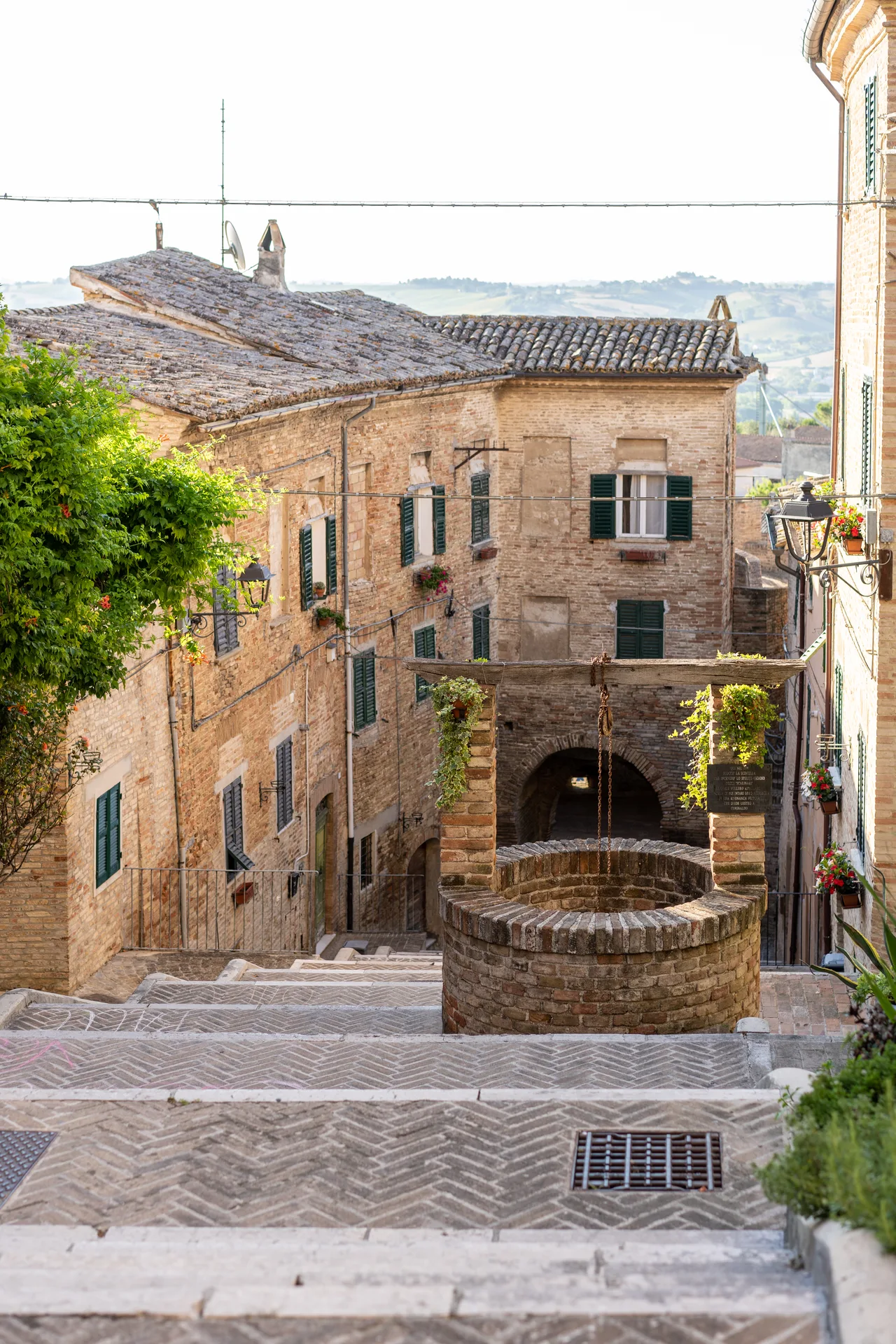
The Pozzo della Polenta (Polenta well)
The House of Scuretto
The story of Scuretto is a bizarre tale, straddling reality and fantasy, that took place in the early 1900s—an example of that touch of genius that sets the people of Corinaldo apart.
Scuretto, whose real name was Gaetano Priori, was a cobbler who lived in a rented house in Corinaldo, and between mending one shoe and another, he never turned down a good glass of wine. He had a son who had emigrated to America in search of fortune but had remained in close contact with his father, so much so that he periodically sent him money for a specific purpose: to build a house in Corinaldo.
However, he spent this money drinking at the tavern or gambling at cards, all the while telling his son that work on the house was progressing. At some point, the son, growing suspicious of how long the work was taking, asked his father for a photo of the new house. Scuretto didn’t lose heart; he built the facade of a house, even adding the house number, climbed a ladder, and had himself photographed leaning out of a window. He sent the photo to his son, claiming that the house was finished and only the shutters were missing (hence the name Scuretto, i.e. shutter). But the photograph was probably not very convincing, since his son stopped sending money and the rest of the house was never completed. For this reason, the house remained in the state in which it can still be seen today: completely lacking floors, load-bearing walls, and a roof—a testament to and documentation of this unique story. The house is located on Via Pozzo della Polenta.
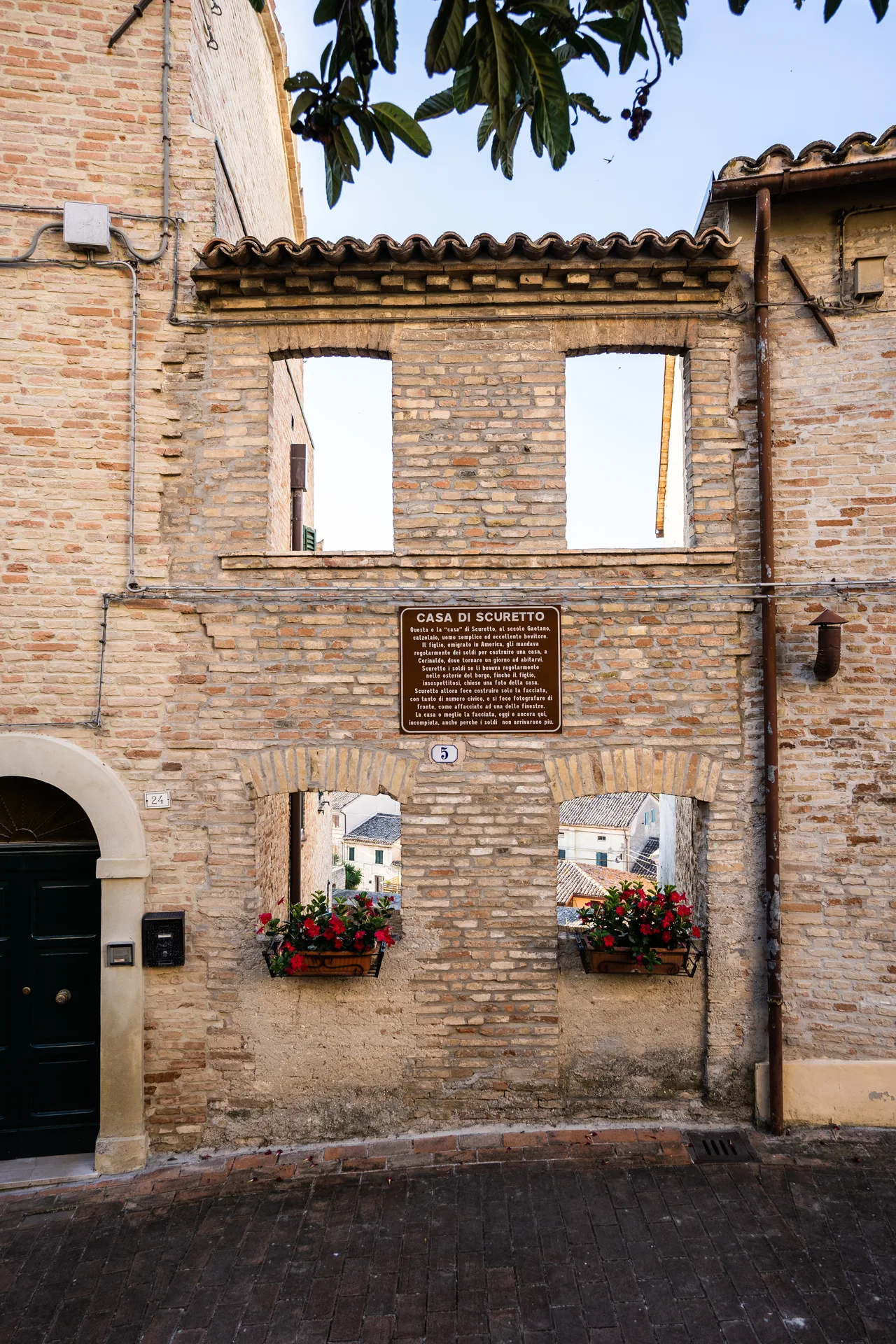
The House of Scuretto
The Fig Tree Cannon: the most creative weapon in local history
he rivalry between Corinaldo and Montenovo (Ostra Vetere) had been going on for some time by the mid-15th century. During one of the conflicts between the two towns, the people of Corinaldo were searching for a decisive weapon to secure victory. After lengthy discussions, a brilliant idea took shape. Unable to build an iron cannon for economic reasons, they decided to craft it from a large fig tree trunk, which was hollowed out and skilfully carved. On the day of the firing, all the citizens gathered on the walls to witness the fall of Montenovo. The seven bravest men held the fig-tree cannon while the commander lit the fuse. A tremendous roar was heard, and when the smoke cleared, the seven lay lifeless on the ground. The commander exclaimed: “The cannon fired so powerfully—so powerfully that seven of us died right here; just imagine how many it must have killed in Montenovo.” A man from Corinaldo who had secretly made his way into the enemy city helped confirm the weapon’s alleged lethality. There, he heard voices counting, “Seven, five, three…” and thought, “What a massacre—they’re still counting the dead!”
In reality, the people of Montenovo were playing “morra”
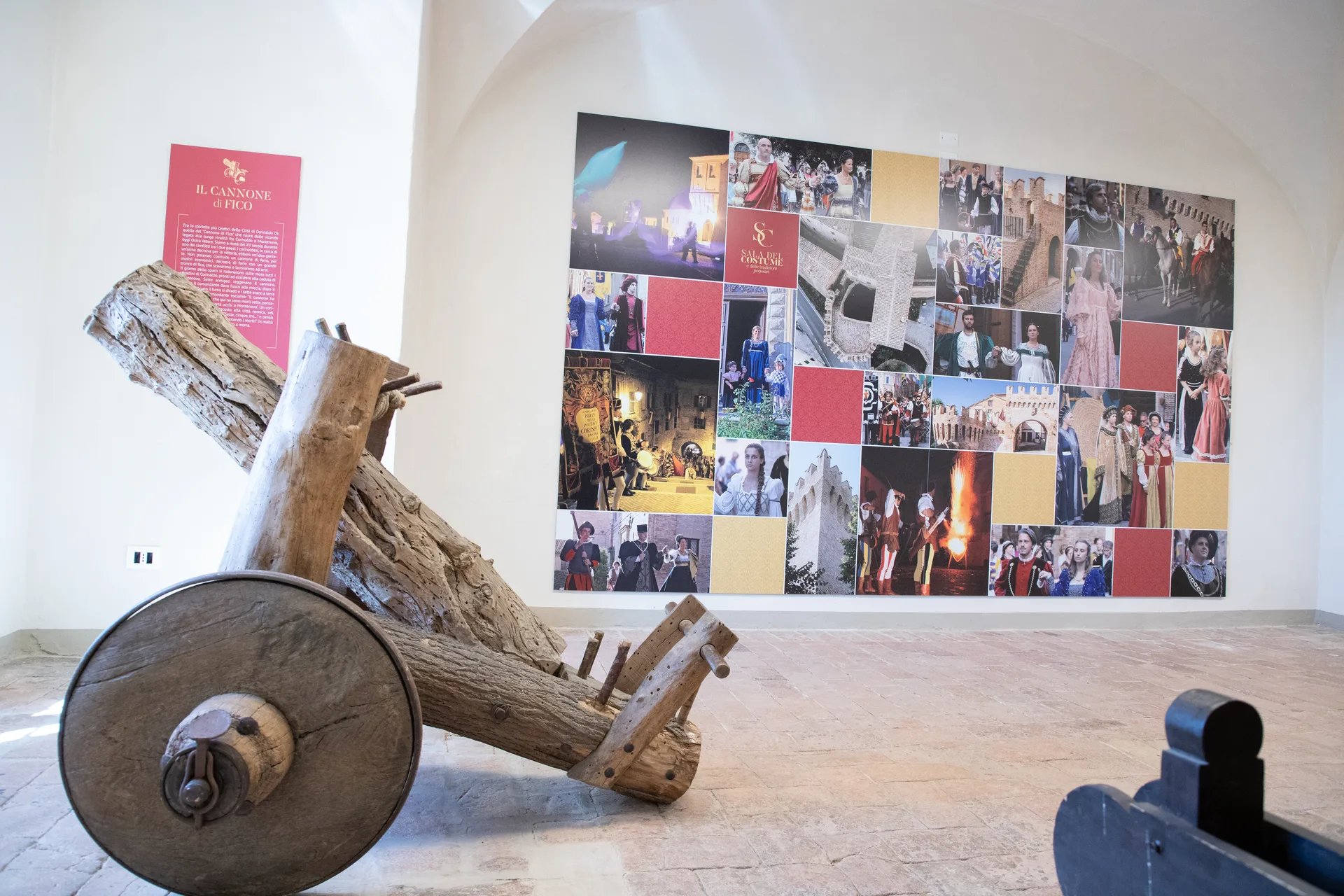
The Cannone di Fico (Fig Cannon), on display in the Hall of Costume and Traditions
Need more information?