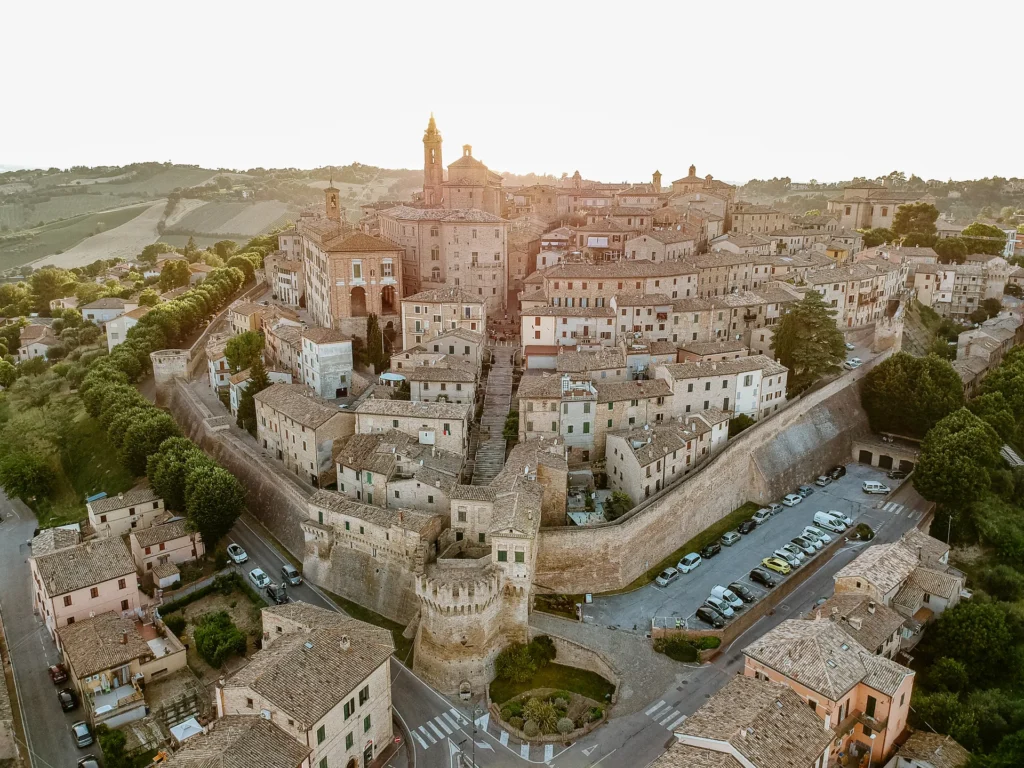
The Town and its Walls
More
Born in Corinaldo on 16 October 1890 and canonised in St Peter’s Square on 24 June 1950 in the presence of her mother. Santa Maria Goretti is venerated throughout the world today. In Corinaldo the places of her childhood are still preserved: her birthplace, the baptismal font and the sanctuary dedicated to her.
Maria Goretti is venerated as a saint and martyr by the Catholic Church, which canonised her on 24 June 1950. Maria was born in Corinaldo on 16 October 1890. Given their conditions of poverty, in 1897 her family moved to the countryside near Rome in search of work.

The Goretti family shared their home with the Serenellis — the father and his son Alessandro. When Maria was almost ten, her father died of the malaria that plagued those areas. Marietta, as she was known, helped her mother by looking after her siblings and the household, sustained by a deep faith in God.
Alessandro, twenty years old when Maria was twelve, made several advances towards her, which she refused. On 5 July 1902, faced with yet another refusal from Maria — who said, “No, no, God does not want it; if you do this you will go to hell” — Alessandro struck her repeatedly with an awl.
Taken to the hospital in Nettuno, Maria died the following day, but not before telling her mother, “For the love of Jesus I forgive him, and I want him to be with me in Heaven.” Alessandro was arrested and spent 27 years in prison; on his release he met Mamma Assunta, and the two were reconciled, in the spirit of Marietta’s forgiveness.
It was precisely the forgiveness of her murderer, together with her steadfast defence of her virtue, that led to Maria Goretti being proclaimed a saint on 24 June 1950 in St Peter’s Square, in the presence of her mother. The saint is known and venerated throughout the world today, and a great many parishes are named after her.
One and a half kilometres from the historic centre, in the “Pregiagna” district, stands the birthplace of Saint Maria Goretti, which is also easily accessible by bus. T his small two-story farmhouse still features a room on the ground floor with elements of the original stable, while the space that once housed the cellar is now a small chapel dedicated to Saint Maria Goretti.
On the upper floor is the dining room, with a fireplace in the centre, and two other rooms. To the left is the bedroom of Luigi Goretti and Assunta Carlini: it was here that “Marietta”—as she was known in the family—was born on October 16, 1890. This room contains original furniture from the Goretti family, including the bed and the painting above the headboard donated by Mamma Assunta.
The Diocesan Shrine of Saint Maria Goretti, located at the highest point of the historic center, is easily recognizable by the bell tower of the Church of Saint Augustine rising above the rooftops of Corinaldo. To the left of the entrance lie the remains of Mamma Assunta, who died in Corinaldo in 1954; to the right are those of Alessandro Serenelli. On the central altar, made of white Carrara marble, next to a wooden sculpture of Saint Maria Goretti, there is a silver urn containing a bone from the saint’s arm—the arm with which the martyr attempted to defend herself against her attacker, Alessandro Serenelli.
In the Parish Church of San Francesco, to the right of the entrance, there is a small monument in white Carrara marble dedicated to Saint Maria Goretti, and facing the monument stands a bust of Pope Pius XII, the pontiff who beatified her on April 27, 1947, and subsequently canonised her on June 24, 1950. Once through the door, you enter the baptistery, where on the right, beneath a round stained-glass window, stands the baptismal font in which the saint was baptised on October 17, 1890.
This was the church closest to the Goretti home, and the little girl would go there to pray, especially during the month of May, which is dedicated to the Virgin Mary; on the first altar on the left, a painter from Corinaldo, Mirco Manoni, has immortalised this devotional moment.
History, folklore, architecture, nature, art, faith: there’s always another side of Corinaldo to discover.
Need more information?

Via del Corso, 11
60013 Corinaldo (AN) – Italy
© 2026 Comune di Corinaldo
VAT no. 00106410426 | Official Municipal Website