Archaeological park of the Roman City of Suasa
Four kilometres from Corinaldo, in the Cesano Valley, lie the remains of an entire Roman city: mosaics, frescoes and an amphitheatre for ten thousand spectators.
Opening hours and admission at parcosuasa.it
Accessible
The Archaeological Park of Suasa: where it is and how to get there
The Regional Archaeological Park of the Roman City of Suasa lies within the municipality of Castelleone di Suasa, in the Pian Volpello district, about 4 km from the centre of Corinaldo.
The origins of Suasa and its urban development
Suasa was founded during the 3rd century B.C. in the middle Cesano Valley, along an ancient route linking the Adriatic coast to the Apennine passes, following the Roman conquest of the territory previously occupied by the Senones Gauls. Probably established as a praefectura — an administrative and judicial centre — the city saw a first, gradual phase of urban and monumental development during the 2nd century B.C. Recent findings attest that in this period there were houses decorated in the manner of contemporary residences of the local aristocracy and of those in Latium and Campania. The period of greatest urban development most likely came around the middle of the 1st century B.C., when the city became a municipium.
The main monuments: domus, forum and amphitheatre
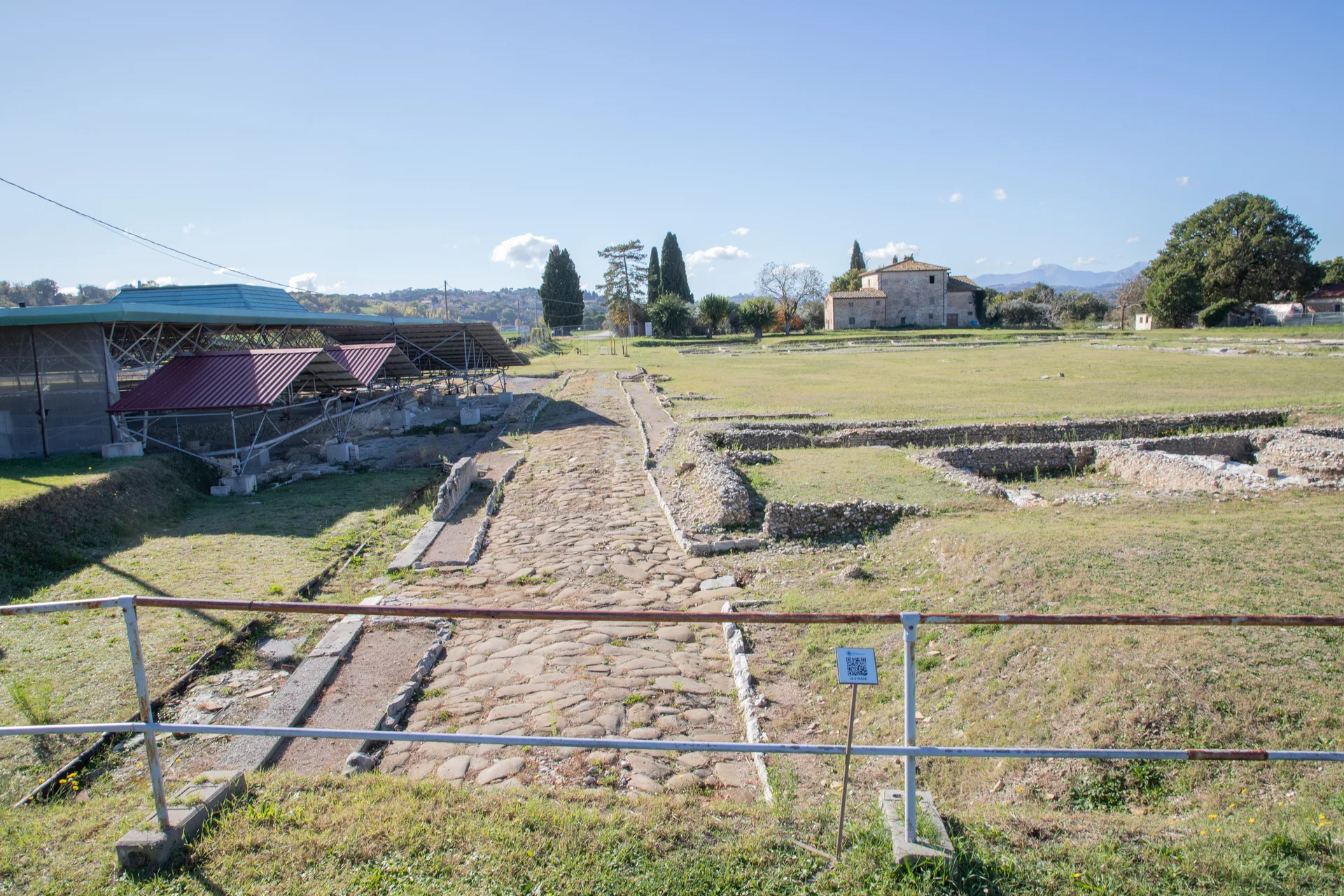
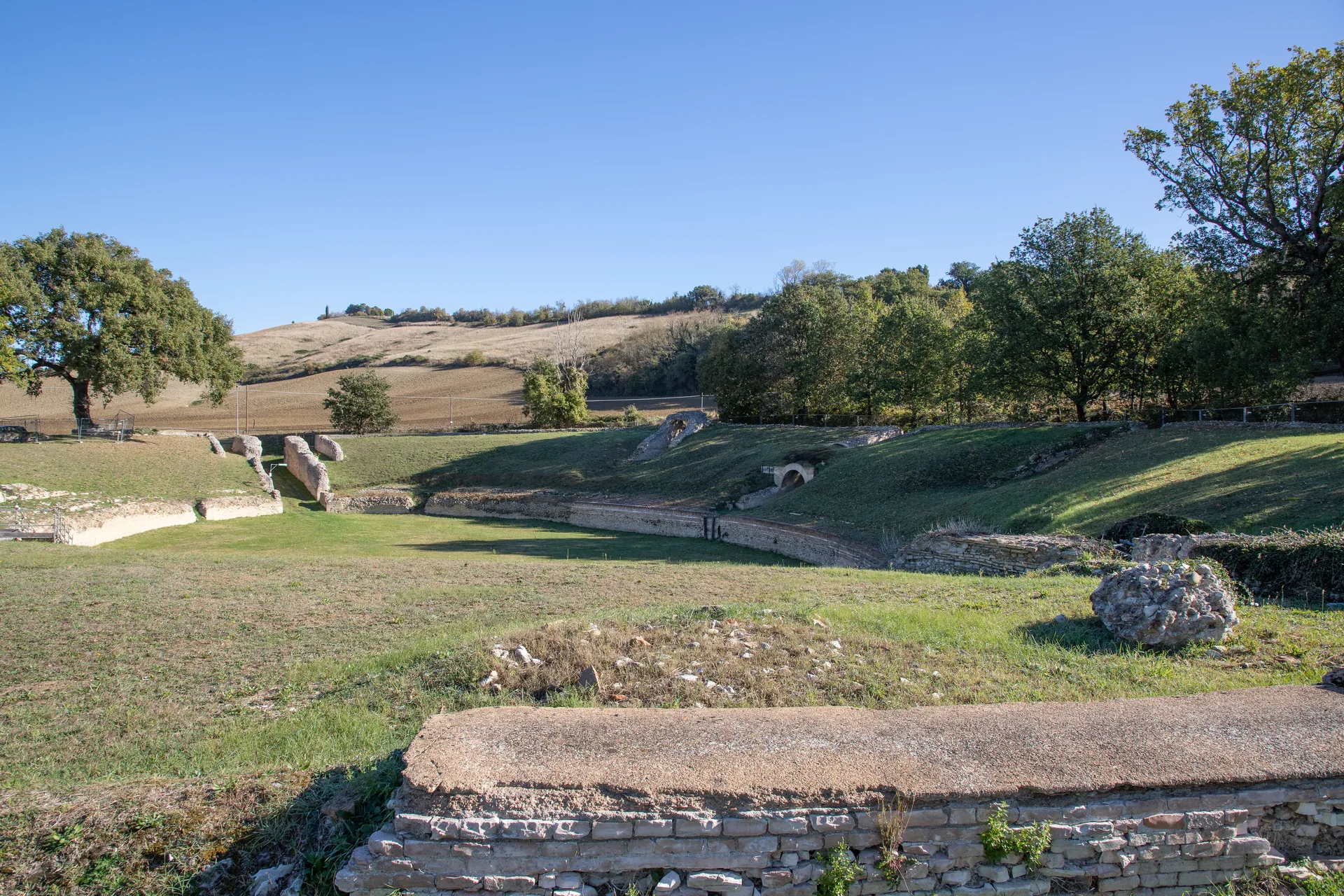
The earliest phase of the great residence of the Coiedii senatorial family dates to this period; it would reach its peak of splendour in the early 2nd century A.D., under the emperors Trajan and Hadrian. In addition to the celebrated porticoed garden with fountains and the private bath quarter, the domus has yielded around twenty mosaic floors of exceptional quality and frescoes in the Pompeian style that are unique in central and northern Italy. Not far from the residence, the Forum has been identified, built in the early 1st century A.D. on an artificial mound of earth and gravel. It is a monumental open courtyard, bordered on three sides by porticoes onto which numerous tabernae open: the square is considered the largest of its kind in the Marche region. During the 1st century A.D. the Amphitheatre was also built, and it has remained visible ever since. Elliptical in shape, it is one of the largest in the region and could hold between 7,000 and 10,000 spectators. To the north and south of the city lay two necropolises, where remains of funerary monuments from the early Imperial period were found, along with numerous tombs dating from after the end of the 2nd century A.D.
The decline of the city and its archaeological rediscovery
Contrary to the tradition that held the city to have been destroyed by Alaric’s Goths in 409 A.D., excavations document a slow and gradual decline, probably linked to the instability of the Gothic War, poor maintenance and the morphology of the valley, which was prone to frequent flooding. The unhealthy conditions of the area drove its inhabitants to take refuge in the surrounding hills, and the site became farmland subject to the looting of stone materials. On various occasions over time, numerous sculptures have been unearthed in the area of the ancient city, many of which were subsequently lost.
The Civic Museum of Castelleone di Suasa and practical information
In the nearby town of Castelleone di Suasa, in the palace that was once the residence of Duchess Livia Della Rovere, the “A. Casagrande” Civic Archaeological Museum is now housed. Here the objects found during the excavations are on display, along with the splendid wall frescoes recovered from the Villa of the Coiedii — a rare and refined example of Pompeian-style painting across the whole of central and northern Italy.
Informazioni aggiuntive
Abaco Società Cooperativa
www.parcosuasa.it
info@parcosuasa.it
tel. +39 375 6720915
Need more information?